Cycling definitely goes well with mellow electronic music where the rhythmic spin of peddling seems to fall easily into sync with the beat. I mostly use this music as it also suits film of the coast, from waves breaking, filming along a tide line of debris and wheels spinning across the sand and also to panning across bays.
There sometime earie offbeat sounds are great for Urban Exploration films too.
As well as music by Phontaine and Mogwai, another band with a Scottish connections i love is the electronic duo Boards of Canada ,
One of my favourite bands, i can lose myself for hours listening to there unique sound. there are loads of great fan made films of there music to watch on youtube and vimeo, some are very very well made and i will be posting some of these along with other favourite bands fan made movies in the future, as it is for myself all linked to coastal cycling and other interests i post on here.
Here is a fantastic fan film to some of Boards of Canada`s song `Happy Cycling`...
boards of canada "happy cycling" from charles andre on Vimeo.
Wednesday, 25 January 2012


Tuesday, 24 January 2012
WW2 XT Class Submarine Wrecks, Aberlady Bay

Half a mile from the high tide line of Gullane Point out in Aberlady Bay on the Aberlady Nature Reserve here in East Lothian lie two wrecks of WW2, exposed at low tide on a sand bar and accessible to visit twice a day are two Royal Navy XT class midget submarines...

Drone Flight; XT Class Sub Wrecks from coastkid71 on Vimeo.
Here is the known history of them, on line and the local history;
They are two of six midget submarines class XT (T - Training) built by Vickers-Armstrong Ltd.
They were manned by a crew of 4. The ship`s were 52ft long and 5ft in diameter.
Their range was generally taken to be 500 nautical miles surfaced and 82 nautical miles submerged.
At a speed of 6.5 and 5.5 Knots and powered by a Gardner diesel engine (as was used in a London bus!) on the surface and battery propulsion below the surface...


1942
The Tirpitz was the flagship of the German Navy in 1942, sister of The sunk Bismarck it was a major threat to Allied shipping in the North Sea on route to Russia...

Using a secret hideout in a secure Fjord in Occupied Norway Tirpitz would lie in wait in the North Sea for convoys where it would pounce then retreat to its secluded hideout. Protected by shoreline anti aircraft and underwater anti-submarine nets and minefields made it a hard target from the air or sea.
In October 1942, an attempt to sink her using chariot 'human torpedoes' failed because of the bad weather but Tirpitz was out of action due to a maintenance overhaul over the winter.
In March she moved to a more remote hideout called Kaafiord in the far north of Norway.
In September 1943, RAF Spitfires based in the Soviet Union took Ariel pictures of the ship and the surrounding anti-torpedo nets in the fjord.
Kaafiord was out of bomber range, so the British would use the X-craft...


Operation Source...
Six X Class submarines named X5 - X10 would be towed 1000 miles across the North Sea by normal subs. If they survived this which would be a mission on its own then they would then detach and head into the Fjord evading minefields, listening posts and the anti-submarine nets surrounding the Tirpitz to drop 2 powerful side cargo`s under the target...

Each loaded with over a ton-and-a-half of Amatex high explosive...

Volunteers had already been training around Loch Cairnbawn on the west coast of Scotland using the XT class (training) versions of the X class submarines...

Training in these cramped craft was crucial for the mental and nervous endurance the crew would under go...

It was a seriously dangerous mission hence why it was crewed by volunteers...

On 11 September Six X-craft were used;
HMS X5, X6 and X7 were allocated the battleship Tirpitz, in Kaafiord.
HMS X9 and X10 were to attack the battleship Scharnhorst, also in Kaafiord.
HMS X8 was to attack the aged pocket battleship Lützow in Langefiord.
The craft were towed to the area by conventional submarines,
HMS Thrasher towing X5...

All were manned by passage crews on the way then close to the target the operation crews would take over.
The crossing of the North Sea must have been cold and cramped and with the condensation pretty grim... not to mention extremely claustrophobic...

X9, probably trimmed heavily by the bow in the heavy sea for the tow, was lost with all hands on the passage when her tow parted and she suffered an abrupt plunge due to her bow-down trim.
X8 (passage crew commanded by Lt. J. E. "Jack" Smart) developed serious leaks in her side-mounted demolition charges, which had to be jettisoned, these exploded leaving her so damaged she had to be scuttled.
The remaining X-craft began their run in on 20 September and the actual attacks took place on 22 September 1943.
Scharnhorst was engaged in exercises at the time, and hence was not at her normal mooring so X10's attack was abandoned, although this was due to mechanical and navigation problems, and the submarine returned to rendezvous with her 'tug' submarine and was taken back to Scotland.
X6 and X7 managed to drop their charges underneath Tirpitz, but were unable to make good their escape as they were observed and attacked.
Both craft were abandoned and six crew survived to be captured. Although the fate of X5 is unclear, it is believed to have been sunk by a direct hit from one of Tirpitz's four-inch guns before having had a chance to place her charges.
In 2004, a saddle charge identical to those used by the X-class was found on the bottom of Kaafiord a short distance from the site of the attack.
Although it has not been positively identified, it is believed to be from the X5.
Tirpitz was lifted out of the water by the explosion and suffered damage and a slight list to port. Electronic and fire control systems were seriously damaged, and all auxiliary machinery either thrown off its housings or damaged internally.
Tirpitz didn't get the damage repaired by the X-craft attack so the midget subs succeeded in damaging the ship keeping her berthed at Kaafiord until 1944 and her sinking later by Royal Navy and Air Force attacks.
Map of Operation Source...

The commanders of the crafts X6 & X7, Lieutenant Donald Cameron (X6) and Lieutenant Basil Place (X7) were awarded the Victoria Cross,
Robert Aitken, Richard Haddon Kendall, and John Thornton Lorimer received the Distinguished Service Order and Edmund Goddard the Conspicuous Gallantry Medal.
The commander of the X8, John Elliott Smart was appointed a Member of the Order of the British Empire (MBE).
Today only one surviving X Class Submarine remains which is now restored in the Royal Navy Museum,
X24...


Here is a documentary film with interviews of some of the surviving crews...
1946;
After the war in 1946 two of the six XT class training subs were towed into Aberlady Bay and moored between 4 Anti Tank Blocks with a single block on top...

Then there were two live fire missions on the subs when they were afloat at high tide to test new experimental explosive cannon shells from aircraft,

One attack by a Supermarine Seafire-the aircraft carrier folding wing Spitfire...

And a De Haviland Mosquito...

Update August 2019;
This week the film of the live fire test has appeared on Youtube, i saw some of this, in black and white on BBC Coast and have searched with no results so to add this is great;
This event is documented on the RCAHMS Canmore website and many of the shells have been found on the reserve years afterwards.
I found many when working as a Green keeper on the Links there in the 1980s, here is one of the shells, or as it should be called a cartridge, not 20mm as were the usual Hispano cannon shells fired by fighters but a 1/2 Inch (.50mm) calibre as more common at the end of WW2 ,the smaller bullets are 303 cartridges shown for comparison...

Local History;
Now what does not seem to be recorded is after the exercise was carried out local fighters based at RAF Drem would strafe the subs for target practise,
How do i know this?- local knowledge, a tractor driver who retired when i was 17 was in the Royal Observers Corps here during WW2 and said there was a marker pole behind the 7th Tee up on the Hill of Gullane No3 Golf Course (base is still there in concrete) and fighters would line up over it and dive down towards the subs and fire once over the line of coastal Defence Anti tank blocks,
Mustangs from 309 Squadron while based at RAF Drem, Gullane hill in back ground...

We used to find the spent cartridges in winter time on what is now today part of the Nature Reserve while lifting turf on a mowed area west of the present No2 course `12th` Green. It is now an area protected for its rare Orchids. I picked up over 160 of spent cartridges in one afternoon while we lifted turf there in the winter of 1987, this was just a small area of i guess about 90 square yards. along with the 1/2" cartridges were the more common larger 20mm Hispano shells, like these two, again the smaller cartridges are .303 rounds...

Again evidence of regular aircraft from Drem using the subs as practise. I gave all the 1/2 inch casings away to friends and now only have the one left now!. There must be hundreds if not thousands of them between the Golf course 12th Green of No2 Course and out towards the sub wrecks.
No mention of further live fire on the subs is documented, but local people witnessed it.
This story seems fair enough as RAF Drem still had fighters stationed in 1946 and also the sheer amount of cartridge shells local folk have found out on the exposed sands at low tide- now grass covered lagoons and the Green keepers found lifting turf over the years in that line from the 7th tee, must be way more in number than fired by just two planes.
I have read that there is film of the munitions test which would be great to see. Some of it was shown on the BBC Coast series when they visited the sub wrecks...
If the sand bar the wrecks lie on ever moves enough to reveal the base of the four anti tank blocks between the wrecks then you will see the rotting chassis of a Willys Jeep, i haven't seen it for about 10 years now.
Every year the wrecks deteriorate more, the wreck to the west of the Tank blocks is in better condition...
It is about a 40 minute walk out to the submarine wrecks from the Nature Reserve car park east of Aberlady village if you want to go and visit them at a low tide, or a 10 minute cycle on a fat bike...
If you do go, and when you see the size of them, have a think about what it must have been like for the men that operated these crafts, the transport crews, as well as the operational crews. They must have had nerves of steel.
Massive respect for there bravery...


Who knows how long they will be visible for at every low tide...

Collecting pictures and some documentary film of `Operation Source` in WW2 as well as pictures from the many times i visit Aberlady Bay, here is a wee film i made of the X and XT crafts...
If you found this East Lothian WW2 history post interesting you may want to read some other related posts;
Gin Head radar research and testing facility
WW2 German POW Cooler explore
Supermarine Spitfire & RAf Drem
Anthrax Island
East Lothian WW2 Royal Observor Corps
An old spoon, with a story
An old tin, with a story
Monday, 23 January 2012
An old spoon, with a story...
My dad gave me something he found years ago in the late 1970s/80s) when he was the County Ranger.
It is an old silver spoon he found out on Aberlady Nature Reserve here in East Lothian amongst the remaining WW2 Coastal Defence Anti Tank Blocks...


Looked like just an old spoon...

Until i looked at the insignia...yep that`s a swastika!

Underneath it is also stamped GROMARGAN GERMANY,
google that and i found there is still cutlery made there today, and they state it to be the finest made too,
It is light for its size and must be good quality stainless steel to have lain outside possibly for 40-50 years.
I found some GROMARGAN cutlery for sale on Ebay, it isn't cheap, this spoon with its insignia could be worth a few quid- but with that swastika unfortunately for the wrong reasons...
Now its a long shot but a probable reason how this spoon with an Army Badge and swastika insignia came to be out there on Aberlady nature reserve was that German POWs from Gosford POW Camp helped work on the Coastal Defences here in East Lothian. The spoon is not a mess kit spoon as issued to troops but a dining spoon, Officers did not do manual labour under the Geniva convention so how did a German squaddie come to own this?, i have had this spoon verified as genuine and not fake by a German reenactment group,
Here is a picture of a German POW beside a block and a sentry watching on the Gullane road, east of Aberlady...

Gosford Camp was extended after the D-Day Landings and would by the Wars end house nearly 4000 Prisoners.
Gosford Camp (No16) 1945...

The Coastal Defences were started after the Dunkirk Evacuation in 1940, the tank blocks on the Nature Reserve were made in August of that year, how do i know?,
Because some have writing on them...
This one is dated Wednesday 21st August...


If indeed it was a POW who lost that spoon, i bet he was in trouble for doing so,
I read that captured soldiers were allowed to keep there mess kits of cups and cooking pots (mess tins) but forks and knives were removed, and all cutting or spreading of butter, jam etc..on food and eating had to be done with that spoon.
A spare spoon or knife could be made to be used as a knife or key, POWs kit was checked daily and a reported missing spoon would probably result in time spent in solitary in the `cooler`, with the intent that the soldier would break and reveal he had traded or sold it to another prisoner...
Now just because the spoon has a swastika does not mean hits owner was a Nazi- something which would not interest me anyway, but i wonder who he was, where he was captured and if like many POWs he stayed here after the War ended or was returned...
We grew up with our parents friends of German ex POWs who stayed here after the war, many worked on the local estates and farms, many that had to return to the former East Germany faced an uncertain fate...
Guess we will never know the story of this WW2 artifact, but its owner was lucky to have been captured as he made it through it all...
If i can ID the Regiment/Group Badge then maybe i could find out the information on POW regiments that were at Gosford Camp, also there was a Camp at Aimsfield in Haddington but most were non German Axis troops,
My friend Tommy `battlefield Detective` in Holland has been researching but has not found an ID on the Regiment badge, if anyone can help please get in touch...
I can just imagine Sweden going to war..there elite troops kitted out with mess kits by IKEA... -:)
An old Tin, with a story...
When i was 14 or 15 i was out walking along the old Right of Way from Lochhill Farm to Aberlady Village on the eastern side of Gosford Estate and just before the 6 Acre Wood i kicked something lying in the long grass...

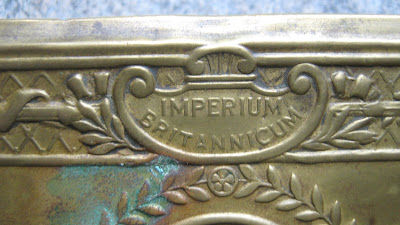
It was an old Tin which looked like it was made of brass as was all green,i took it home and cleaned it up to reveal its markings, it was from the first world war in Christmas 1914...


Princess Mary was the daughter of King George V and Queen Mary.
She was 17 when War broke out in 1914...

As the first Christmas of the War approached Princess Mary wanted to contribute to the commonwealth forces a gift for Christmas....
Due to the scale of this it was decided best that an appeal fund was set up in her name, Hers words to the people were;
"I want you now to help me to send a Christmas present from the whole of the nation to every sailor afloat and every soldier at the front. I am sure that we should all be happier to feel that we had helped to send our little token of love and sympathy on Christmas morning, something that would be useful and of permanent value, and the making of which may be the means of providing employment in trades adversely affected by the war. Could there be anything more likely to hearten them in their struggle than a present received straight from home on Christmas Day,
Please will you help me?"
Money poured in by the public only too keen to make there loved ones fighting have an enjoyable Christmas, though `the war that would be over by Christmas` was now looking to be a long affair and the true horror of trench warfare was starting to become knowledge by returning wounded and rising numbers of the fallen...
It was decided a box would be sent to the sailors and soldiers in service of the Commonwealth as an appreciation of there bravery...


There were approx 500,000 boxes made...
There were two contents in the boxes, one for smokers, one for non smokers,
Non Smokers box included a packet of acid tablets, a khaki writing case containing pencil, paper and envelopes together with the Christmas card and photograph of Princess Mary...

Smokers box included one ounce of pipe tobacco, twenty cigarettes, a pipe, a tinder lighter, Christmas card and photograph of the Princess...

Along with letters and cards from family and loved one these boxes must of been a welcome gift to the young men at Christmas in 1914,
For infantry sat in a cold trench in terrible conditions with death all around or sailors on ships in constant fear of torpedo attacks at anytime...
I wonder who it was who lost the box i found, was he a survivor?
or was it a tin sent home with personal belongings of a fallen soldier or sailor?
The box is 100 years old now, a relic from `The War to End All Wars`...
But still there is fighting in the world...
You can read more about the Princess Mary Appeal Fund and the Boxes on line here at;
The Imperial War museum...

It was an old Tin which looked like it was made of brass as was all green,i took it home and cleaned it up to reveal its markings, it was from the first world war in Christmas 1914...


Princess Mary was the daughter of King George V and Queen Mary.
She was 17 when War broke out in 1914...

As the first Christmas of the War approached Princess Mary wanted to contribute to the commonwealth forces a gift for Christmas....
Due to the scale of this it was decided best that an appeal fund was set up in her name, Hers words to the people were;
"I want you now to help me to send a Christmas present from the whole of the nation to every sailor afloat and every soldier at the front. I am sure that we should all be happier to feel that we had helped to send our little token of love and sympathy on Christmas morning, something that would be useful and of permanent value, and the making of which may be the means of providing employment in trades adversely affected by the war. Could there be anything more likely to hearten them in their struggle than a present received straight from home on Christmas Day,
Please will you help me?"
Money poured in by the public only too keen to make there loved ones fighting have an enjoyable Christmas, though `the war that would be over by Christmas` was now looking to be a long affair and the true horror of trench warfare was starting to become knowledge by returning wounded and rising numbers of the fallen...
It was decided a box would be sent to the sailors and soldiers in service of the Commonwealth as an appreciation of there bravery...


There were approx 500,000 boxes made...
There were two contents in the boxes, one for smokers, one for non smokers,
Non Smokers box included a packet of acid tablets, a khaki writing case containing pencil, paper and envelopes together with the Christmas card and photograph of Princess Mary...

Smokers box included one ounce of pipe tobacco, twenty cigarettes, a pipe, a tinder lighter, Christmas card and photograph of the Princess...

Along with letters and cards from family and loved one these boxes must of been a welcome gift to the young men at Christmas in 1914,
For infantry sat in a cold trench in terrible conditions with death all around or sailors on ships in constant fear of torpedo attacks at anytime...
I wonder who it was who lost the box i found, was he a survivor?
or was it a tin sent home with personal belongings of a fallen soldier or sailor?
The box is 100 years old now, a relic from `The War to End All Wars`...
But still there is fighting in the world...
You can read more about the Princess Mary Appeal Fund and the Boxes on line here at;
The Imperial War museum...
Subscribe to:
Posts (Atom)


